


 突發新聞
突發新聞
 鋒爆新聞
鋒爆新聞 Mar 01 2026
 29547
29547 鋒爆新聞
鋒爆新聞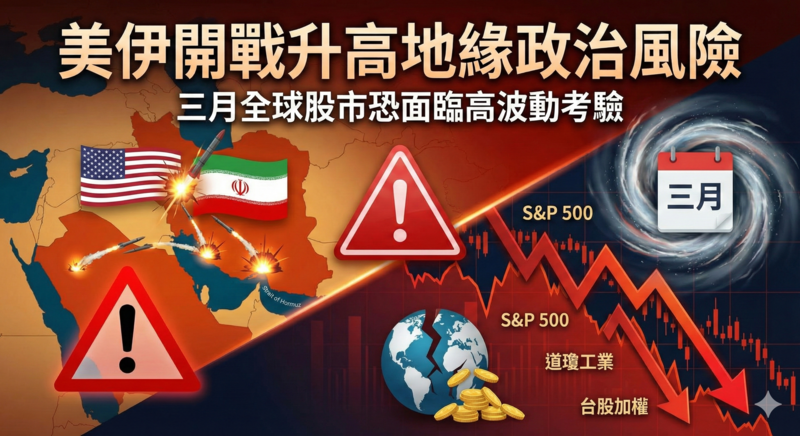
(Image/AI-generated illustration)
The conflict between the United States and Iran has officially erupted today. Following the military action launched by the US and its allies against Iran, the situation in the Middle East has formally entered a war phase, and risk aversion in global financial markets has risen rapidly. The market generally believes that the timing of the conflict coincides with the first quarter's fund adjustments and the corporate earnings season, which could lead to significant stock market volatility in March, and even short-term corrective pressure. Analysts point out that the impact of this event on the stock market will be transmitted through four main channels: oil prices, inflation expectations, fund flows, and industry rotation.
I. War triggers risk aversion, putting short-term pressure on global stock markets.
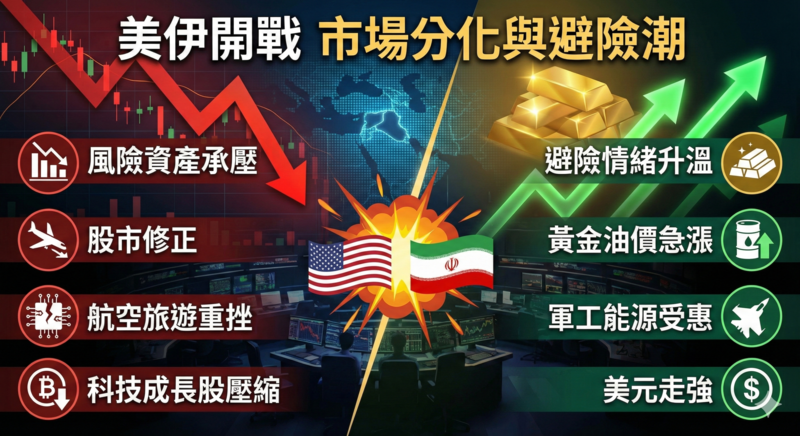
Following the outbreak of the US-Iran conflict, the market's immediate reaction was a decline in risk assets and a rise in safe-haven assets. Market sources indicate that after the announcement of the airstrikes, oil and gold prices surged simultaneously, while cryptocurrencies and equity stocks experienced volatility, with investors quickly shifting to more conservative positions. Historical experience shows that in the early stages of geopolitical conflicts, global stock markets typically experience an immediate drop of about 1% to 2%, while defense and energy stocks may buck the trend and rise. Market experts predict that since the Taiwan and US stock markets were already at high levels before the conflict, if panic continues, a sharp drop or gap correction may occur at the start of trading in early March, with short-term volatility increasing significantly.
(Image/AI-generated illustration)
II. Oil prices become the biggest variable in the stock market in March.
The core impact of this conflict lies in energy supply. The Middle East controls vital global oil shipping routes; if the conflict escalates or affects the Strait of Hormuz, global supply could be disrupted. Analysts point out that if the conflict continues, Brent crude could quickly rise to $80 per barrel, and even challenge $100 in a prolonged conflict. Currently, oil prices have already risen to a seven-month high due to tensions, with the market already pricing in a supply risk premium. The impact of rising oil prices on the stock market is two-sided:
• Negative aspects
o Increased business costs and inflation
o Postponing the timing of interest rate cuts by central banks around the world
o Compressing corporate profit expectations
• Facing
Energy and oil services stocks benefit
o Stock markets in some resource-rich countries have been relatively resilient to declines
Experts point out that if oil prices stabilize above $80, it will become a significant pressure zone for global stock markets.

Third, industry performance will show significant differentiation.
War is not entirely negative for the stock market; rather, it accelerates industry rotation. The market has already shown a typical reaction recently:
Affected industries
Airlines and travel stocks were hit hardest. Rising oil prices directly increased fuel costs, causing the stock prices of several US airlines to plummet by 6% to 8% or more in a single day, marking their biggest drop in nearly a month. Furthermore, the consumer, transportation, and manufacturing sectors may also face downward revisions in profits due to rising costs.
Beneficiary industries
• Oil and energy company stocks rise as oil prices increase
• The defense industry is attracting investment due to expectations of increased military spending.
• Gold and resource stocks attract safe-haven funds
Market observations show that energy ETFs and the share prices of major oil companies have begun to rise in tandem.
GAMA Collaboration Coffee with Yimi Coffee

IV. Changes in Fund Flows Lead to Increased Market Volatility in March
The uncertainty brought about by war has led to a reshuffling of global capital allocation. Analysis indicates that:
• Investors turn to the US dollar and safe-haven currencies
• Emerging market capital may flow out in the short term
• Growth stock valuations face compression
Increased demand for safe-haven assets could also push up the US dollar, putting downward pressure on the New Taiwan dollar and other Asian currencies, further increasing the risk of foreign capital outflows from the stock market. Furthermore, if energy prices drive up inflation, the US Federal Reserve may delay its interest rate cuts, which would be particularly detrimental to technology stocks that heavily rely on a low-interest-rate environment.
(Image/AI-generated illustration)
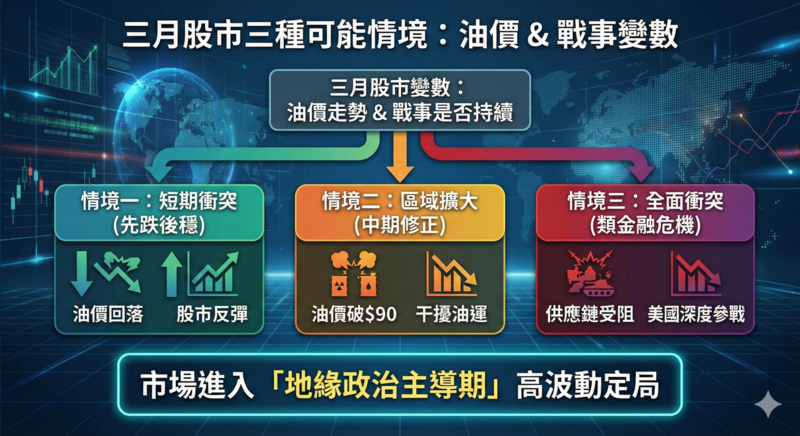
V. Three Possible Scenarios for the Stock Market in March
The market currently uses the "degree of escalation of the conflict" as the core factor in judging the market trend in March.
Scenario 1: Short-term conflict (high probability)
• Limited military operations
• Oil prices briefly surged before falling back
• Stock market rebounds after sharp drop
→ March saw a pattern of "first falling, then stabilizing".
Scenario 2: Regional War Expansion
• Iranian retaliation or disruption of oil shipments
Oil prices break through $90
→ Global stock markets enter a mid-term correction
Scenario 3: Full-scale conflict
• The United States is deeply involved in the war
• Global supply chains disrupted
→ The market may experience financial crisis-like volatility.
Analysts point out that the nature of the first strike often determines the subsequent market trend. If the conflict is controllable, volatility will gradually decrease; otherwise, uncertainty will persist for a long time.
VI. The investment market has entered a period dominated by geopolitics.
Overall, a potential war between the US and Iran means that the market's dominant factor has shifted from "economic data" to "geopolitical risk." With energy, military, and diplomatic uncertainties intertwined, the stock market in March may exhibit the following characteristics:
• The index fluctuated more widely
• The pace of sector rotation is accelerating.
• Safe-haven assets outperformed growth stocks
• News-driven market trends
Investment institutions generally believe that the market focus in the coming weeks will be on three indicators: oil price trends, whether the war continues or even escalates, and whether major oil-producing countries increase production to stabilize supply. Overall, the US-Iran conflict has introduced significant uncertainty into the financial markets for the first quarter of 2026. While the stock market may not necessarily enter a long-term downtrend in March, high volatility is almost a certainty. Investors will face an "event-driven market" dominated by war risks and characterized by rapid market shifts. If the situation does not de-escalate quickly, defensive asset allocation and a wave of safe-haven flows in global stock markets are likely to become the main theme of the March market.

Breaking News
(Article by Dr. Li Yubo)



熱門新聞











你的選擇?

2025台灣跨年 哪裡過?